
Technology is moving from experimentation to enterprise advantage
The central technology story for 2026 is not that frontier technologies are advancing in isolation. It is that several of them are beginning to combine into new operating models that alter productivity, risk management, customer experience and industrial execution.
Artificial intelligence is becoming the coordination layer. Agentic AI moves the market beyond copilots into systems that can plan, act, call tools, coordinate agents and execute multi-step workflows under human oversight.
Compute, connectivity and energy are now strategic constraints. AI demand is putting pressure on semiconductors, cloud capacity, data centres, edge architecture and electricity supply. Technology strategy must therefore be integrated with capital planning, resilience and sustainability.
Trust is no longer a compliance afterthought. Digital provenance, AI security, privacy engineering, post-quantum readiness and cyber resilience are becoming prerequisites for scaled adoption.
For boards and executive teams, the key question is: Which combination of technologies should we use to transform a specific business outcome, and what operating model will let us scale safely?
Ten implications for executives
- AI moves from assistant to operating layer - Business processes will be redesigned around human-agent teams, not merely augmented with chat interfaces.
- Agentic AI needs explicit accountability - Every agent workflow needs a business owner, permission boundaries, logging, escalation and kill-switch controls.
- Data centre and chip economics matter - Technology strategy must account for GPU and chip supply, model cost, energy access and architecture choices.
- Cybersecurity expands into AI governance - Shadow AI, prompt leakage, model abuse and AI supply-chain risk require board-level oversight.
- Post-quantum migration starts now - Cryptographic inventories and transition roadmaps should begin before quantum risk becomes operationally urgent.
- Edge, cloud and sovereignty converge - Regional cloud, edge processing and data sovereignty are design variables in regulated sectors.
- Robotics and physical AI enter practical deployment - High-value cases combine sensors, AI, mobility, safety systems and workflow redesign.
- Workforce strategy becomes technology strategy - Talent demand shifts toward AI management, data engineering, cybersecurity and change leadership.
- Sustainability becomes a scaling constraint - Boards need to monitor energy demand, data centre location, cooling and carbon impact.
- Value cases beat experimentation - The winners will treat technology adoption as a portfolio of measurable business outcomes.
What changed in 2026
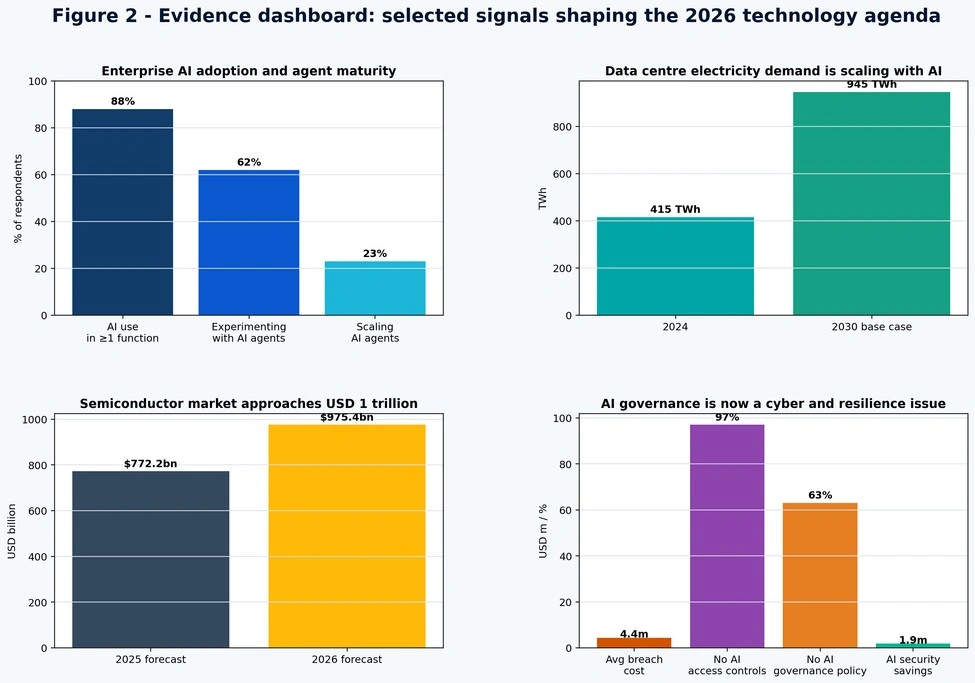
AI adoption is broad, but enterprise impact remains uneven. Many organizations use AI in at least one function, while the move from experimentation to repeatable value is still immature.
Agentic AI is becoming a board topic because the risk profile changes when systems can act, transact, coordinate and use enterprise tools. The control question shifts from output quality to authorization, evidence and accountability.
Infrastructure constraints are visible. Data centre energy demand, AI chips, model economics, cooling and network capacity are becoming practical business constraints rather than background technology issues.
Digital trust is becoming a growth enabler. Provenance, identity, cyber resilience, AI security, data governance and post-quantum readiness increasingly influence whether an organization can safely scale new technology.
Robotics, physical AI and automation are moving from isolated pilots to practical productivity programs in sectors where safety, quality and 24/7 operations matter.
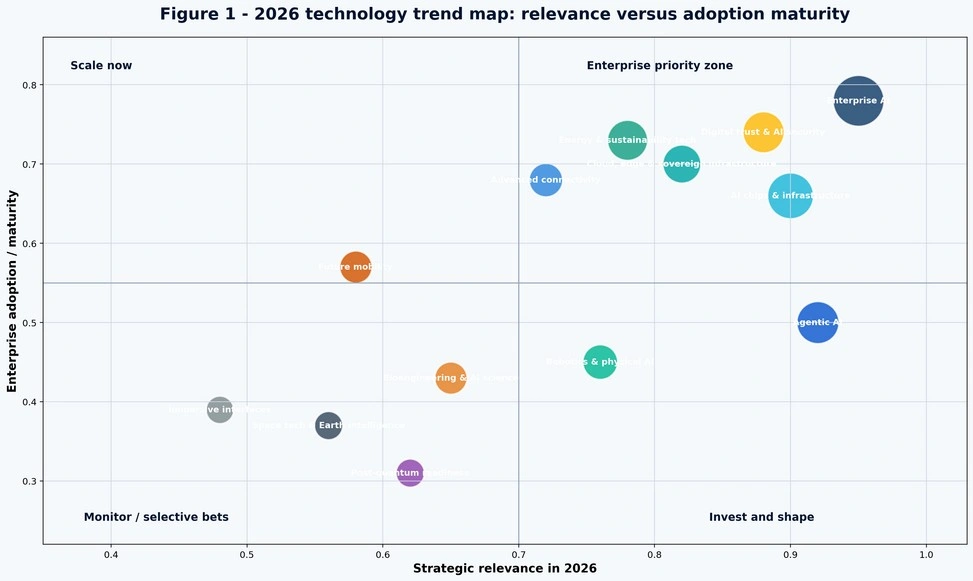
The 13 technology trends for 2026
Strategy&Consult groups the 2026 agenda into three executive lenses:
- AI and autonomy
- Compute, connectivity and trust
- Physical-world transformation
The value is highest where technologies combine around a measurable business outcome.
1. Agentic AI and autonomous workflows : AI systems that plan, act, call tools and coordinate tasks across business processes.
2. Enterprise AI and multimodal intelligence : AI embedded into customer service, finance, risk, product, coding, operations and decision support.
3. AI-native software engineering : Natural-language coding, automated testing, code review agents and platform engineering.
4. Application-specific semiconductors : GPUs, accelerators, high-bandwidth memory, AI chips and inference optimization.
5. Cloud, edge and sovereign infrastructure : Hybrid, regional, edge and sovereign architectures for resilience, latency and control.
6. Advanced connectivity : 5G, private networks, satellite connectivity and industrial IoT communication layers.
7. Digital trust and cybersecurity : Identity, provenance, AI security, zero trust, cyber resilience and third-party assurance.
8. Quantum technologies and post-quantum readiness : Quantum computing, sensing, communications and cryptographic migration.
9. Robotics and physical AI : Autonomous machines using perception, sensing, mobility and AI decisioning.
10. Future mobility and autonomous systems : Connected, electric and increasingly autonomous movement of people, goods and services.
11. Bioengineering and AI science : AI-assisted discovery, biological engineering, precision medicine and laboratory automation.
12. Space technologies and Earth intelligence : Satellite communications, geospatial intelligence and space-enabled monitoring.
13. Energy and sustainability technologies : Grid intelligence, storage, clean energy, energy optimization and climate-related technology.
Trend-by-trend executive implications
Agentic AI: from copilots to managed digital labour
Use agents in bounded workflows where tasks, tools, permissions, data access and escalation thresholds are explicit. The first wave of scale will come from finance operations, customer support, software development, procurement, regulatory evidence and knowledge work.
AI infrastructure: the new capacity planning discipline
AI performance is no longer only a model issue. It depends on chips, memory, networking, power, data pipelines, cooling and workload placement. Enterprises need a capacity plan for both centralized scale and edge deployment.
Digital trust: provenance, identity and cyber resilience
As synthetic content, autonomous agents and AI-generated code become normal, organizations need evidence that data, models, content and actions are authentic. Trust architecture becomes a growth enabler.
Post-quantum: a long migration with early decisions
Quantum risk is a reason to inventory. Long-lived sensitive data, regulated records, financial infrastructure and critical systems require migration planning because cryptographic change is slow.
Robotics and physical AI: productivity beyond the screen
Robotics is becoming more attractive where labour availability, safety, quality and 24/7 operations matter. Use cases should integrate robotics with sensors, connectivity, AI perception and workflow redesign.
Energy and sustainability: digital scale meets physical constraint
AI can optimize energy use and maintenance, but AI infrastructure can increase electricity demand in concentrated locations. Boards should include energy and sustainability in technology adoption decisions.
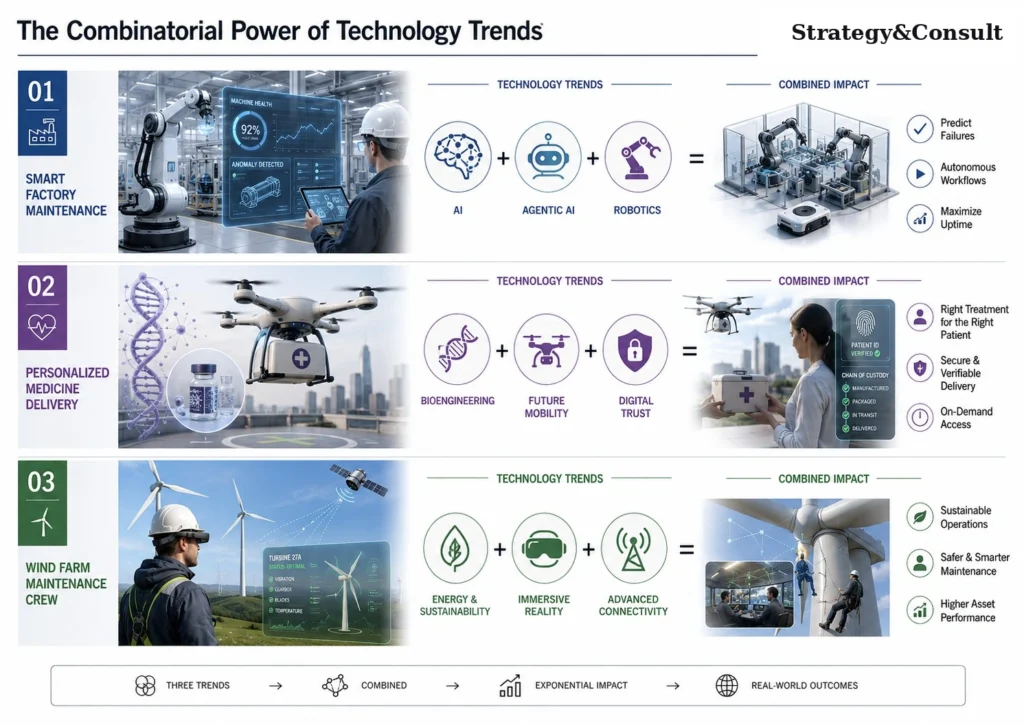
Where combinations create defensible advantage
Single technologies create efficiency. Combinations create new operating models. The most compelling use cases combine AI, data, trust, infrastructure and physical-world technologies around a defined business outcome.
Financial services and fintech . AI agents for finance operations, credit memo drafting, fraud triage, compliance evidence and customer servicing. Controls should emphasize Data quality, Explainability, Model validation and Regulatory evidence.
Healthcare and life sciences. AI-assisted clinical documentation, imaging workflows, precision medicine, bioengineering and logistics. Controls should emphasize Privacy, Clinical safety, Bias, Approval pathways and Secure interoperability.
Industrial, logistics and energy. Robotics, predictive maintenance, digital twins, advanced connectivity, edge AI and energy optimization. Controls should emphasize Safety, Uptime, OT cybersecurity and Network resilience.
Public sector and smart infrastructure. Citizen services, geospatial analytics, identity, transport optimization and sovereign cloud. Controls should emphasize Procurement, Data sovereignty, Transparency, Inclusion and Public trust.
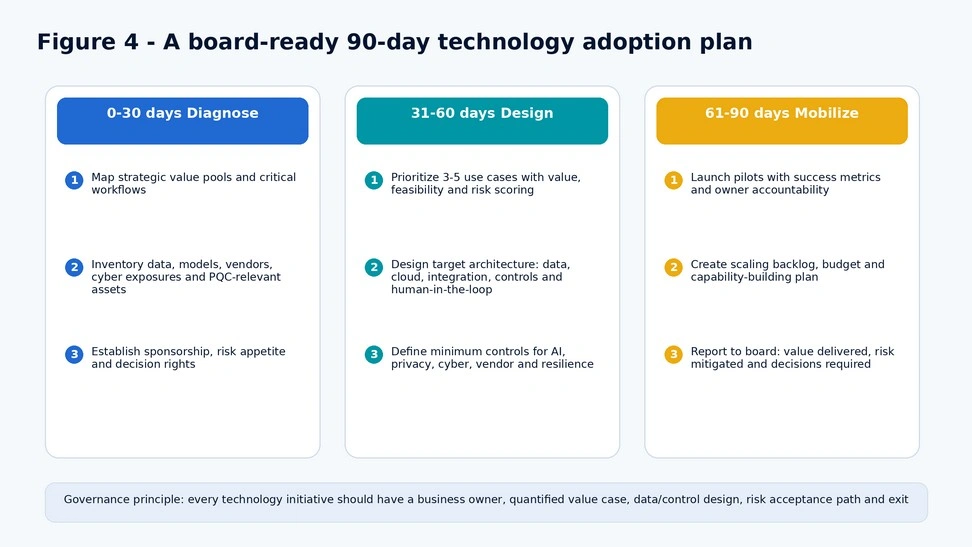
A practical 90-day plan for executives
The objective is not to chase every trend. The objective is to create a disciplined portfolio of technology initiatives tied to business value, risk acceptance and operational readiness. A 90-day plan to move from fragmented experimentation to controlled mobilization.
Questions the board should ask
- Which 3-5 technology use cases have the clearest measurable value over the next 12 months?
- Which workflows need to be redesigned, not merely automated?
- Who owns AI agents, model outcomes, data rights, escalation and control failures?
- Where do we have concentration risk in cloud, chips, vendors, data centres or critical third parties?
- Do we have an inventory of AI systems, models, sensitive data, third-party AI tools and cryptographic dependencies?
- How will technology adoption affect workforce size, skills, role design and employee accountability?
- What are our cyber, privacy, resilience and post-quantum priorities for the next budget cycle?
- Which metrics will show business value, risk reduction and scaling readiness to the board?
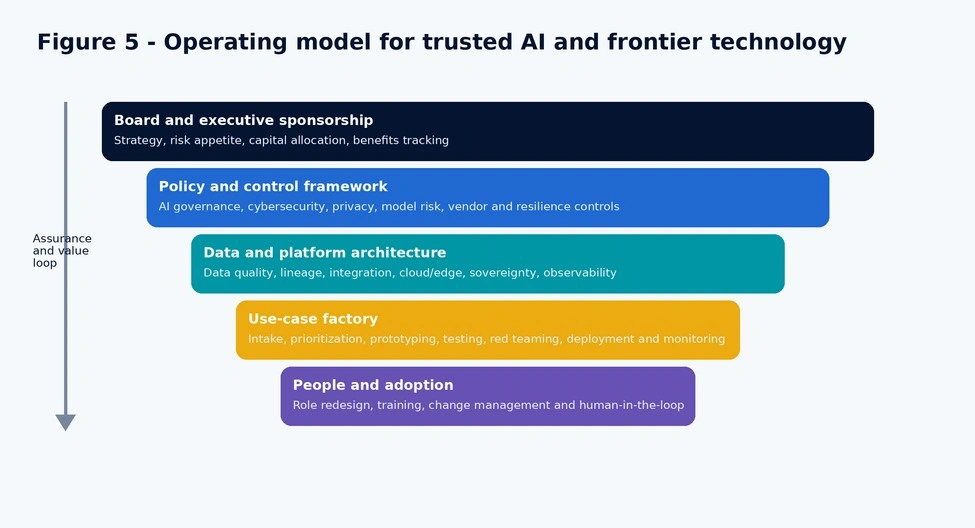
Trusted AI and frontier-technology operating model
Technology scale should be treated as a controlled operating model, not as a collection of tools. Sponsorship, policies, architecture, use-case delivery and workforce adoption should operate as a closed assurance and value loop. Operating model for trusted AI and frontier technology.
AI inventory. Register AI tools, models, agents, vendors and use cases. Classify by Risk, Business owner and Data access.
Data governance. Define Lineage, Quality thresholds, Retention, Lawful basis, Access rights and Sensitive data handling.
Model and agent controls. Test Accuracy, Bias, Robustness, Prompt injection, Tool-use risk, Escalation behavior and before deployment.
Cybersecurity. Apply Identity security, Privileged access, Logging, Monitoring, DLP, Secure development and Third-party risk controls.
Post-quantum readiness. Identify quantum-vulnerable cryptography, Prioritize Long-lived sensitive systems and Migration plans
Benefits tracking. Measure Cost savings, Revenue uplift, Cycle-time reduction, Risk reduction, Customer impact and Employee impact.
- Stanford HAI, 2026 AI Index Report
- Gartner, Top Strategic Technology Trends for 2026
- International Energy Agency, Energy and AI: Energy demand from AI
- SIA / WSTS, global semiconductor sales and 2026 forecast
- International Federation of Robotics, World Robotics 2025
- IBM, Cost of a Data Breach Report 2025
- NIST CSRC, Post-Quantum Cryptography project
- World Economic Forum, Future of Jobs Report 2025
- Google Cloud, AI agents and the future of work in 2026
- Deloitte Insights, Tech Trends 2026